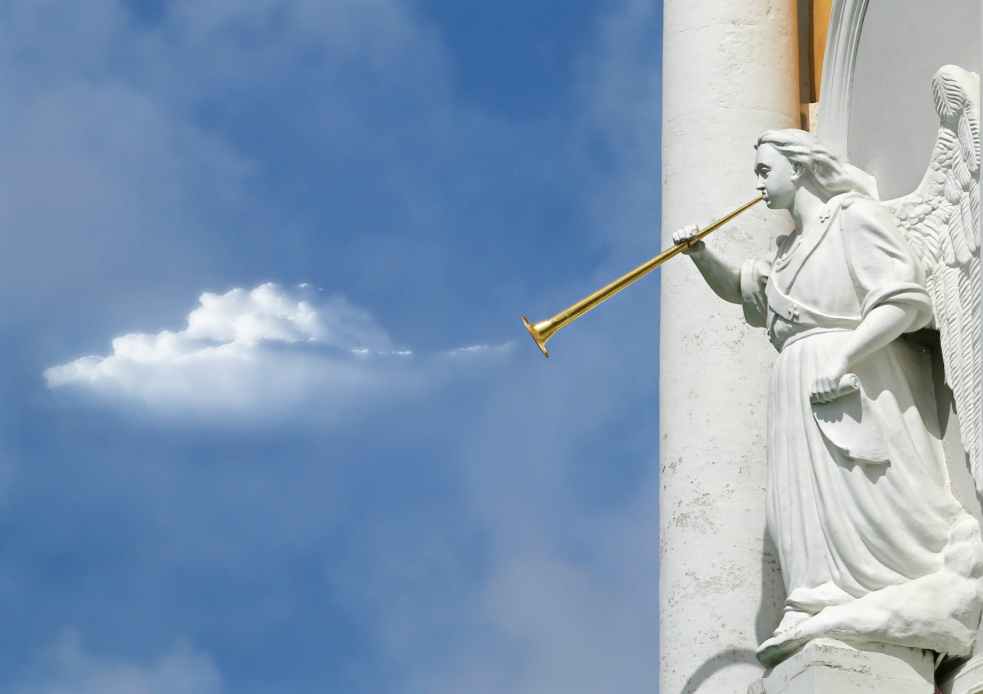
It’s the familiar Christmas hymn we sing every year, or at least that we watch the Peanuts gang sing at the end of A Charlie Brown Christmas every year. But because it’s so familiar, because the language is somewhat archaic, and because the words go by so quickly with the (rightly) triumphant melody, I fear we miss Charles Wesley’s masterpiece of a theology lesson, for Hark! The Herald Angels Sing may be the most theologically rich Christmas hymn ever written. Take a moment with me to allow Wesley’s poetry to guide our meditation on the birth of Christ.
Verse 1
Hark! the Herald Angels sing,
“Glory to the newborn King;
Peace on Earth, and Mercy mild,
God and Sinners reconciled.
Joyful all ye Nations rise,
Join the Triumphs of the Skies,
With th' angelic Host proclaim,
Christ is born in Bethlehem.
Hark! the Herald, Angels sing,
“Glory to the newborn King."
Let’s start by explaining the language, because poetically this is beautiful but you really have to sink your teeth into it to understand what Wesley is saying. The opening line Hark! the Herald Angels sing is calling us to listen (Hark!) to the angels proclaiming (heralding) the news through song. Immediately, our minds should be drawn to Luke 2 and the account of the multitude of the heavenly host that proclaimed the news to the shepherds.
Verse 1 paraphrases the angels’ message in Luke 2:10–14:
| Lyric | Luke 2 reference |
| Glory to the newborn King | “Glory to God in the highest” (2:14) |
| Peace on Earth, and Mercy mild [mild, as in God is not severe with us] | “on earth peace” (2:14) |
| God and Sinners reconciled | “a Savior, who is Christ the Lord” (2:11) |
Then Wesley calls all nations to rise and join in the song of the angels, telling us to proclaim that Christ is born in Bethlehem.
Verse 2
Christ by highest Heaven ador'd,
Christ the everlasting Lord;
Late in Time behold him come,
Offspring of a Virgin's Womb;
Veil'd in Flesh, the Godhead see,
Hail th' Incarnate Deity!
Pleased as Man with men to dwell
Jesus, our Immanuel.
Hark! the Herald, Angels sing,
“Glory to the newborn King."
Having directed our ears to the angels and called us to proclaim Christ’s birth, Wesley now turns to theology and mines the depths of what is going on as Christ comes to earth. In the second verse, he leads us to meditate on the incarnation of Christ, how Jesus took on human form.
First, he shows us where Christ was before he came to earth. He was the everlasting Lord enthroned in heaven, adored by even the highest ranking members of the heavenly host.
Now we look at how Jesus came late in time, or put another way, we’ve been waiting for this for a long, long time. He’s the offspring of a virgin as prophesied by Isaiah. And marvel at the mystery that we can look upon God as he is veiled in human flesh. It’s too much to keep silent, so Wesley practically shouts, Hail, the Incarnate Deity!, that is to say, greet this King with the homage due to Him as we are filled with awe that Jesus is incarnated.
Some modern-day versions of the hymn change Pleased as Man with men to dwell to be gender-neutral, but the preferred alternate lyric (Pleased as God with us to dwell) loses all the theology. Wesley wants us to see that Christ is the Man who has come to dwell (make a home) with us. Jesus, our Immanuel makes it personal, calling Jesus our God with us.
Verse 3
Hail the Heav'n born Prince of Peace!
Hail the Son of Righteousness!
Light and Life to all he brings,
Ris'n with Healing in his Wings;
Mild he lays his Glory by,
Born, that Man no more may die,
Born to raise the sons of Earth;
Born to give them second Birth.
Hark! the Herald, Angels sing,
“Glory to the newborn King."
In the third verse, Wesley turns to praising the newborn Christ for the sacrifice he will make to save sinners. First, because we can’t praise Jesus enough, and because even in praise we can insert theology, Wesley gives us two lines of sheer praise: Hail the Heav’n born Prince of Peace!, that is to say, praise to the prince who is the heir of heaven. Hail the Son of Righteousness!, giving us some trinitarian language as Jesus is the Son. It’s also a clever play on words that we’ll see in a minute.
Now Wesley tells us what Jesus came to do, which is why we are praising him with such splendor. Light and Life to all he brings. And then, possibly my favorite line, Ris’n with Healing in his Wings. This is the play on words, where Wesley takes the word Son, reminds us that sun sounds the same, and then draws our attention to Malachi 4:10, which prophesies, “the sun of righteousness shall rise with healing in its wings.” With a simple pun, Wesley shows us that Christ fulfills this prophecy, not in his rising from the grave, but in his birth as he rises like the sun upon the sin-darkened earth.
As we sing Mild he lays his Glory by (mild refers to Christ’s humility), we sum up in three lines why Christ was born: He was born that man would no longer die, in the sense of eternal life. He was born to us, the sons of earth—and here’s another reference to the Son (sun) of righteousness, as we will rise with him in his second advent. And he was born to give his own a second birth, new life through his blood.
Verse 4
“Verse 4?!” you say. “I didn’t know there was a verse 4!” Yep, there’s a fourth verse, and it’s a good one, though possibly the one that needs the most explanation to understand the older language:
Come, Desire of Nations, come,
Fix in us thy humble Home;
Rise, the Woman's conq'ring seed,
Bruise in us the Serpent's Head;
Adam's Likeness now efface,
Stamp thine Image in its Place;
Second Adam from above,
Reinstate us in thy Love.
Hark! the Herald, Angels sing,
“Glory to the newborn King."
Wesley brings it all home to us. We’ve considered Christ’s glory, his incarnation, and his mission. Now we pray for him to do his sanctifying work in us. First we ask Christ, the desire of nations, to come and dwell in us. Then, referencing Genesis 3:15, we pray for Christ, the woman’s conquering offspring, to bruise the serpent’s head in us, or put another way, to drive out our sinful nature.
We ask for our ancestor Adam’s image to be removed (efface means to erase a mark that mars a surface) and for Christ’s own image to be stamped upon us in the place where we bore the image of Adam.
Then, we pray that the second Adam, Christ, would reinstate us. That is, we ask that in us, mankind’s former Garden privilege of fellowship with God would be restored through Christ’s love toward us.
So there you have it! A hymn full of the glories of Christmas, taking us through the Gospel story and tuning our hearts to sing to our great Savior.
 Hymnal Poetry